

Where to Live Near the TSMC Phoenix Campus: A North Phoenix Neighborhood Guide
If you're moving to Phoenix for work in the semiconductor corridor, you've probably already run into the hard part. It isn't finding a house. It's that the Valley looks small on a map and doesn't drive small, and every neighborhood name someone hands you sounds about the same when you're reading it from a thousand miles away.
We're up here every day. We show these neighborhoods, we live in them and our kids are growing up here. So here's the guide we'd give a friend who called and said, "I took the job, now where do I live?"
One note before we start, we've sorted this by drive time instead of by price or popularity. After walking a lot of people through this move, we've learned that the commute is the decision everything else gets built around.
1. Start with the geography, not the listings
The campus sits in far north Phoenix, near 43rd Avenue and Dove Valley Road, in the North Gateway area. There are exactly two ways to approach it: Loop 303 from the south, and I-17 from the east. That's it. A large mixed-use district is being built around the campus over the next couple of decades, and more retail and housing fills in around Dove Valley Road every year but the road geometry is the thing to plan around, and that part won't change.
What this means practically: neighborhoods that sit near I-17 or near Loop 303 commute well, even from a surprising distance. Neighborhoods that are close as the crow flies but have no direct road and there are several commute worse than the map suggests.
Two honest disclaimers on the drive times below. They're ranges, not promises, and Valley traffic can make liars out of all of us. And we'd always tell you to drive your actual route at your actual start time before you write an offer. Nobody regrets doing that.
2. The short-drive band: roughly 10 to 20 minutes
These are the closest-in options, and they're overwhelmingly newer construction. If your priority is getting home fast, start here.
Norterra, Union Park at Norterra, and Fireside at Norterra — West of I-17 around Happy Valley and Jomax, and about as close as you can get with a real neighborhood around you. Fireside is built out and amenity-heavy: fitness center, pools, splash pad, courts, and trail access into the Sonoran Preserve and Deem Hills. Union Park is the newer piece, and it's designed to be the most deliberately walkable thing in north Phoenix tree-lined streets, shade corridors, and a planned retail and restaurant corridor at its center. Worth saying plainly: it's still building out, so some of what's on the plan isn't open yet. Homes range from attached product up through larger single-family. The tradeoff: lots are modest. You're buying location and walkability, not land. And because this is the obvious answer for corridor commuters, it's a competitive pocket.
Sonoran Foothills — East of I-17, off the Sonoran Desert Drive corridor. Mid-2000s master-planned, a mix of gated and non-gated sections sharing one central amenity package, with a K–8 school right inside the community. Honestly, this might be the best all-around balance on the list. The tradeoff: the HOA structure is layered a base community assessment plus neighborhood-level dues that vary by section, so two homes three streets apart can carry different numbers. Ask us to pull the specifics for any home you're considering.
Tramonto — Right at Carefree Highway, one of the shortest drives here, with preserve access and groceries five minutes away. Denser than its neighbors, with everything from close-set patio homes to hillside lots that back the preserve and run large. The tradeoff: the housing mix is less cohesive than a single-builder community, and parts feel tight.
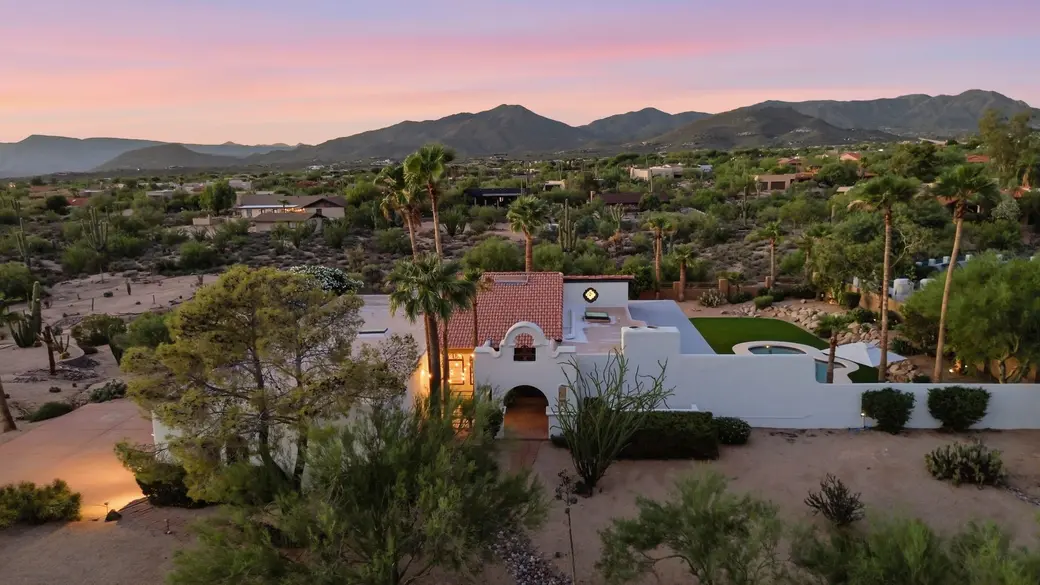
Stetson Valley — Tucked against the Deem Hills with I-17 on its eastern edge. Early-2000s, Spanish-revival stucco with tile roofs, wide sidewalks, great mountain views, and no through traffic on residential streets. One thing we'll be straight about: people sometimes expect an older, shadier neighborhood here and that's not what it is. The landscaping is young desert, not canopy. It's a lovely, coherent community just know what you're getting.
The Dove Valley area itself — The newest construction, the shortest drive, and the most new amenities coming. The tradeoff: you're buying into an area that's still being built. Roads, retail, and schools are catching up to the growth, and the neighborhood character isn't settled yet. Some people find that exciting. Some people find it exhausting. Both reactions are fair.
3. The middle band: roughly 20 to 30 minutes
This is where the commute gets real but the tradeoffs get interesting.
Anthem — Master-planned, amenity-rich, and genuinely walkable inside its villages. A big community center with an Olympic-size pool, a water park, pickleball, and an adjacent community park with fields, a fishing pond, a skate park, and an amphitheater. Mostly late-1990s through mid-2000s homes, with a newer pocket in Circle Mountain Ranch. Parkside is the ungated core, Country Club is guard-gated with two golf courses and worth knowing, it isn't age-restricted, despite how it reads. The tradeoff: multiple HOAs plus a community assessment, and you're paying for a large amenity package whether you use it or not.
Desert Ridge — Freeway-to-freeway on Loop 101 to I-17, which makes the drive cleaner than the mileage suggests. Built on a super-block concept that clusters schools, parks, and shopping within walking distance, with the Marketplace, the Musical Instrument Museum, and Reach 11's twenty-odd miles of trails right there. Probably the single most popular landing spot for relocating households, and there's a reason. The tradeoff: it's polished and master-planned rather than organic, with the HOA density and the sameness that come with that.
Arrowhead — Over in Glendale, and visually the least desert-looking place on this list: lakes, greenbelts, tree-lined streets, two country clubs with championship courses, and Thunderbird Conservation Park next door. Developed in phases from the late 1980s through the early 2010s, so there's real variety in home size and age. The tradeoff: it's a different city, which means different services and permitting, and the lakes and greenbelts mean a meaningfully involved HOA.
Vistancia — Peoria, out by Lake Pleasant, and better than people assume because it's freeway the whole way on Loop 303. Newer construction than almost anything else here, resort-grade amenities, and a 55+ section in Trilogy. The tradeoff: it's the one community here in Peoria Unified rather than Deer Valley Unified, and the commute depends entirely on Loop 303 with no good alternate.
Deer Valley — The Phoenix village, not the ski town, and not one neighborhood so much as a large area with quiet subdivisions wrapped around a commercial and industrial core. Long build-out, so you'll find everything from 1960s traditional to 2010s stucco, generally on smaller lots. It's the practical, value-conscious entry point to the corridor. The tradeoff: character varies block to block, so you're buying the specific subdivision rather than the area. And parts of it sit near Deer Valley Airport, which is one of the busiest general aviation fields in the country.
4. The established band: roughly 25 to 40 minutes
This is where the mature trees are, and it's where we spend most of our time. Be honest with yourself about the drive but if what you want is a neighborhood with a history, this is the trade.
Moon Valley Built around Moon Valley Country Club, whose course dates to around 1960, and made up of 29 subdivisions south and east of Coral Gables Drive, west of 7th Street, north of Thunderbird Road. Mature palms and mesquite, sidewalks, pools, hillside streets on the east side with city views. Homes are largely 1970s and 80s Mediterranean-influenced ranch, and because they've been remodeled over decades, almost every one is one-of-one. Lots run from under a quarter acre to over half. The tradeoff: older bones, older systems, older floor plans, and roughly double the drive of the close-in options.
Lookout Mountain Quieter and more custom than Moon Valley, with homes climbing the flanks of the preserve and trailheads walkable from some streets. Mostly 1970s through 90s, ranch and Southwest custom, often on irregular hillside lots that are larger than the flat-grid norm. The tradeoff: hillside living means grade, driveways, and retaining walls.
The Sheaborhood What locals call the stretch along Shea Boulevard against the Phoenix Mountains Preserve. It's a nickname, not an official designation, and the edges are soft. It's also had a genuine renaissance independent restaurants, a bouldering gym, coffee, a walkable commercial spine, which is rare up here. Homes are 1960s through 90s on larger lots with real landscaping. The tradeoff: it's the longest drive in this band. This is a lifestyle choice, and that's a fine reason to choose it just choose it on purpose.
Paradise Valley Village — And here's the one that confuses every single out-of-state buyer, so let's clear it up. Paradise Valley Village is a City of Phoenix urban village. The Town of Paradise Valley is a separate incorporated town, and it's south of the Village. Different governments, different character, different price conversation entirely. The Village is established and leafy in the older pockets, with mid-century ranches, infill new builds, and smaller-lot luxury side by side, plus preserve access and the Indian Bend Wash greenbelt.. The tradeoff: it's a long drive to the corridor.
5. If you want acreage and the water conversation that comes with it
Some of the best-value land in the Valley is north and northeast of the campus, and the commute is often better than people expect, because you're coming at it from a different direction.
Cave Creek is rustic and Western, with a real historic downtown, acreage parcels common, and a lot of horse-zoned property. Carefree is smaller and architecturally deliberate, concentrated in gated master-planned communities. Both are a genuinely reasonable drive often better than Moon Valley or the Sheaborhood, which surprises people.
Desert Hills and New River are the acreage answer: unincorporated county, no HOA in most of it, custom homes on large lots, horses and workshops and shops normal, dark skies at night. If you want a barn, an RV, and nobody telling you what color to paint the house, this is it.
And now the part almost nobody tells relocating buyers, which is the most important paragraph in this post:
Much of Desert Hills and New River is not on a municipal water system. Homes there commonly run on private wells, shared wells, or hauled water delivered into on-site storage tanks, and on rural county land you should expect on-site wastewater rather than sewer. Some parcels are reached by dirt road or easement, so legal access and road-maintenance responsibility have to be confirmed. There's an EPCOR water fill station serving these communities, though eligibility rules have shifted before, so confirm directly with them rather than assuming. None of this is a dealbreaker, and plenty of people live this way happily for decades. But it is a completely different ownership experience than turning on a tap in Norterra, and it has to be diligenced parcel by parcel. Well depth and yield, shared-well agreements, tank capacity, hauling arrangements, wastewater condition.
Every other community in this guide is on piped municipal water. If you're coming from a part of the country where water is something you never think about, this is the single biggest adjustment on the list. We'd rather you hear it from us now than from an inspector later.
6. Five things out-of-state buyers don't know to ask
1. School district lines don't follow city lines or zip codes. Not even a little. A zip code can straddle two districts, and two houses on the same street can feed different high schools. District names don't always match where the school physically sits, either. Always verify by address, through the district's own locator.
2. HOA structure is layered here. In several master-planned communities you'll have a base community assessment plus a neighborhood-level assessment on top, and the second one varies by section. Ask for both numbers on every home.
3. Water and wastewater are a real due-diligence item outside city limits. See above. Ask early, not at inspection.
4. Direction matters more than distance. Coming at the corridor from the north, Cave Creek, Carefree, Desert Hills, can beat coming from an established neighborhood that's closer on paper but has to route through two freeways.
5. Drive it before you buy it. Your actual route, at your actual start time, on a weekday. Every time.
7. So how do we actually narrow this down?
Here's the shortcut we use with clients. Answer these four and the list usually collapses to two or three neighborhoods.
- What's the longest drive you'd be genuinely fine with in five years? Not what you'd tolerate month one five years.
- New construction, or a house with a history? These pull in opposite geographic directions here, and that's the real fork in the road.
- Do you want land, or do you want amenities? You can have one easily. Both is a much shorter list.
- Are school boundaries part of this decision? If yes, we work backward from the schools and it changes everything.
Let's find your corner of it
Moving across the country for a job is a lot, and picking a neighborhood from listing photos is a rough way to do it. Carve out a little time when you're in town and we'll drive these with you the close-in ones and the established ones, back to back, so you can feel the difference instead of guessing at it. Honestly, an afternoon in the car tells you more than a month of scrolling.
We're here for you, whether you're six months out or you already have a start date.
— Jessie & Stephen S&J Real Estate Team | W & Partners
Categories
Recent Posts


Get In Touch With Us!